

2BeNomadic — New Stuff Showcase

Article placeholder text

Field-tested gear · 2kWh class

Four Serious Portable Power Stations 

for Off-Grid Life

If you think a 2,000-watt power station is overkill, you’ve clearly never tried to keep a mini-fridge cold, a laptop streaming, two phones charging, a CPAP humming, and a coffee maker gurgling while a storm outside turns your neighborhood into the Dark Ages. This is the line between “romantic off-grid adventure” and “we are now eating warm yogurt in the dark.”

On the road, a 2,000-watt unit means you can run an induction cooktop for actual meals instead of mystery granola, keep your portable fridge from turning into a biology lab, top off camera batteries, blow up the air mattress and power the electric blanket so you don’t wake up as a human popsicle. In civilization, it’s how you become a legend at the tailgate—running a TV, speaker, and electric griddle like a pop-up diner—or the hero of a blackout, calmly brewing coffee and reheating leftovers while your neighbors debate whether candles count as “cooking.”

A good 2,000-watt power station isn’t just backup power; it’s the quiet, rechargeable force field standing between you and cold coffee, dead devices, and total morale collapse.

The four units we’re looking at:

  • Bluetti Elite 200 V2
  • Jackery Explorer 2000 v2
  • EcoFlow DELTA 3 Max
  • Anker SOLIX C2000 Gen 2
  • All four pack around 2 kWh of LiFePO₄ storage and 2.2–2.6 kW of AC output, but they diverge on charge speed, size, apps, and customer support.

    Share how you use your power

    Tell us what you’re running now and what you’d like to run next. This demo form doesn’t send data anywhere yet—but it shows exactly the kind of questions you can ask readers.

    Brand Overview
    Bluetti logo
    Jackery logo
    2kWh
    Power Stations
    EcoFlow logo
    Anker SOLIX logo

    First Impressions: Four Different Personalities

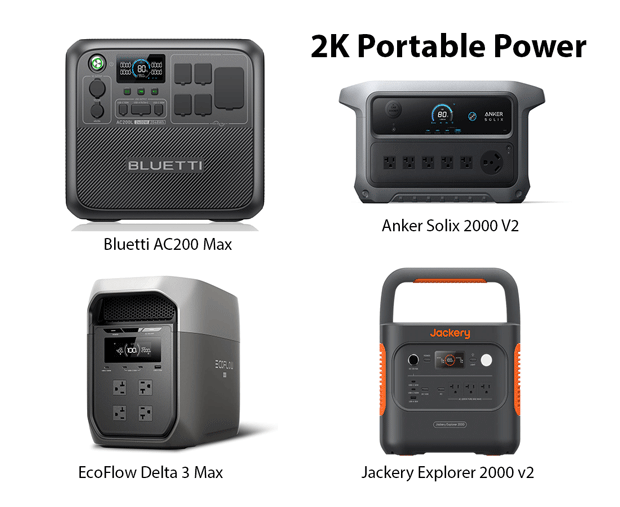
    Looking at each unit’s marketing photos, you can see four distinct personalities. Bluetti Elite 200 V2 presents as a compact, industrial workhorse: dark grey housing, bold Bluetti logo, and a tight front control panel. It looks like a unit you’d leave in a cabin, shop, or van full-time.

    Jackery Explorer 2000 v2 leans into mobility. The charcoal grey body with bright orange accents, plus a telescoping handle and wheels, makes it clear this is built to roll from the car to the campsite, or from one side of the garage to the other.

    EcoFlow DELTA 3 Max has a taller tower-style design with big side vents and a prominent front display. It looks like a mini power server or battery tower, which fits its role as the fast-charging hub of an energy system.

    Anker SOLIX C2000 Gen 2 takes a modern, minimal approach: clean grey and black housing, side cooling fins, and often a subtle LED light bar. It reads as efficient, smart, and expandable—less of a “toolbox” and more like a piece of AV gear.

    Product Cards

    Quick visual at-a-glance for each unit:

    Those visual cues line up with how each unit behaves in real use: Bluetti for grunt, Jackery for portability, EcoFlow for speed, and Anker for efficient control.

    Product Gallery

    Bluetti Elite 200 V2

    Bluetti Elite 200 V2 portable power station

    Compact 2kWh workhorse with 2,600W output and a tight control panel layout.

    Jackery Explorer 2000 v2

    Jackery Explorer 2000 v2 portable power station

    Travel-focused design with wheels, telescoping handle, and bold orange accents.

    EcoFlow DELTA 3 Max

    EcoFlow DELTA 3 Max portable power station

    Tall, vented tower-style chassis built for aggressive cooling and fast charging.

    Anker SOLIX C2000 Gen 2

    Anker SOLIX C2000 Gen 2 portable power station

    Clean, modern cube with GaN-powered charging and a subtle LED light bar.

    Key Specs at a Glance

    All four stations cluster around 2,000 Wh of LiFePO₄ capacity. Where they diverge: Bluetti slightly edges the others on raw watt-hours and output, Jackery is significantly lighter, EcoFlow and Anker lead on charge speed, and EcoFlow/Anker have slightly larger footprints.

    Model Battery (Wh) AC Output (Cont./Surge) Weight (lb) Dimensions (L × W × H, in) Footprint (sq in)
    Bluetti Elite 200 V2 2073.6 2600W / 5200W ~53.4 13.78 × 9.84 × 12.74 ≈136
    Jackery Explorer 2000 v2 2042 2200W / 4400W ~39.5 13.2 × 10.4 × 11.5 ≈137
    EcoFlow DELTA 3 Max 2048 2400W / up to ~3000W (X-Boost) ~44.8 ~19.45 × 9.41 × 12.0 ≈183
    Anker SOLIX C2000 Gen 2 2048 2400W / 4000W peak ~41.7 18.1 × 9.8 × 10.1 ≈177

    MSRP vs. Black Friday Reality

    On paper, these units list around $1,500–$1,700. In big sales—Black Friday, launch promos, and holiday events—they often drop into the $750–$900 band, making features and form factor more important than MSRP.

    Model MSRP / Typical Amazon List Recent Promo or Black Friday Pricing
    Bluetti Elite 200 V2 ~$1,699 ~$799–899 in major promotions
    Jackery Explorer 2000 v2 ~$1,499 ~$799 in large holiday sales
    EcoFlow DELTA 3 Max ~$1,499 ~$759–799 in early Black Friday sales
    Anker SOLIX C2000 Gen 2 ~$1,498–1,499 ~$799 in launch / Black Friday promos

    Exact Amazon pricing moves constantly and varies by region. Always confirm live prices before publishing or purchasing.

    Visual Comparisons

    Capacity vs. Fast-Charge Time

    3D bar chart comparing capacity and charge time for four 2kWh-class power stations

    All four cluster around 2 kWh. EcoFlow DELTA 3 Max and Anker SOLIX C2000 Gen 2 achieve roughly one-hour 0–100% AC charges, while Bluetti Elite 200 V2 and Jackery Explorer 2000 v2 sit closer to the 1.5–1.7 hour mark.

    Illustrative Market Share

    Pie chart showing illustrative relative market share of Jackery, EcoFlow, Bluetti, and Anker

    Jackery and EcoFlow typically appear most often in retailer rankings and review guides, with Bluetti and Anker close behind. This chart is illustrative, based on visibility and review presence—not official market data.

    Customer Service Perception

    Bar chart showing relative customer service perception scores for each brand

    Relative customer service perception on a 1–5 scale, based on general review sentiment. Every brand has both glowing and negative anecdotes; buying from authorized channels and registering your product helps smooth support experiences.

    Customer Support & Bluetooth App Experience

    Customer Support

    On paper, all four brands offer multi-year warranties in the 2–5 year range, sometimes longer for flagship models. In practice, user experiences are mixed: some owners report fast, helpful resolutions and generous replacements, while others describe slow responses or extra hoops before getting a fix.

    EcoFlow and Anker often receive praise for clear communication and modern online support portals. Jackery is frequently highlighted for straightforward parts replacement and reasonably fast email conversations. Bluetti support stories are more polarized—some users rave about excellent service, others report long delays, especially during large sale periods.

    The safest path is to buy through authorized channels, keep receipts and serial numbers, and register the unit so support can quickly find your purchase history if something goes wrong.

    Bluetooth apps: How they feel

    Each brand ships a companion app that connects via Bluetooth and/or Wi-Fi so you can monitor state of charge, real-time input/output, and remaining runtime, and toggle outputs remotely.

    Bluetti’s app leans on a dark, device-centric layout with a large SOC number and cards for AC/DC outputs. It feels like a control panel built around a hero shot of the device.

    Jackery’s app looks like a smart-home dashboard: a summary card for battery and runtime, with tiles below for AC, DC, and solar. Each tile shows watts and acts as an on/off switch, plus settings for standard vs. fast charging.

    EcoFlow’s app is the most system-oriented, with animated power-flow diagrams (solar → grid → battery → loads) and statistics over time. It feels like a mini energy console for a larger ecosystem.

    Anker’s SOLIX app is clean and minimal. You get a device list, then a simple control page with one big battery percentage and grouped toggles for each output and LED controls. It’s quick, efficient, and less visually busy than EcoFlow’s.

    Which One Should You Choose?

    Put it all together, and you get four distinct strengths:

    Bluetti Elite 200 V2

    Best if you want maximum output headroom—2,600 W continuous and 5,200 W surge— in a compact footprint, and you’re okay with extra weight. Great for small home backup and heavier loads like power tools, heaters, and induction cooking.

    Jackery Explorer 2000 v2

    The traveler’s choice. Significantly lighter than most peers, with built-in wheels and a telescoping handle. Perfect if you’re constantly setting up and tearing down camp, or moving power between vehicles.

    EcoFlow DELTA 3 Max

    The speed demon and ecosystem backbone. Its roughly one-hour 0–100% AC charges are a game changer if you only have short generator or shore-power windows. Great if you’re building a smarter energy system around multiple EcoFlow components.

    Anker SOLIX C2000 Gen 2

    The efficient all-rounder. Fast GaN-based charging, solid output, and a very clean app and hardware design. Ideal if you care about efficiency, fast top-ups, and expandability without going to the largest chassis on the floor.

    The good news: during major sales, these often land in the same price range. That means you can choose based on how you live, not just what you can afford. For rolling between campsites, lean toward Jackery. For fast recharge cycles and energy-system integration, EcoFlow or Anker shine. For maximum grunt and long off-grid stretches, Bluetti is hard to ignore.